
For more than five centuries, coffee has grown in the mountains of Yemen.
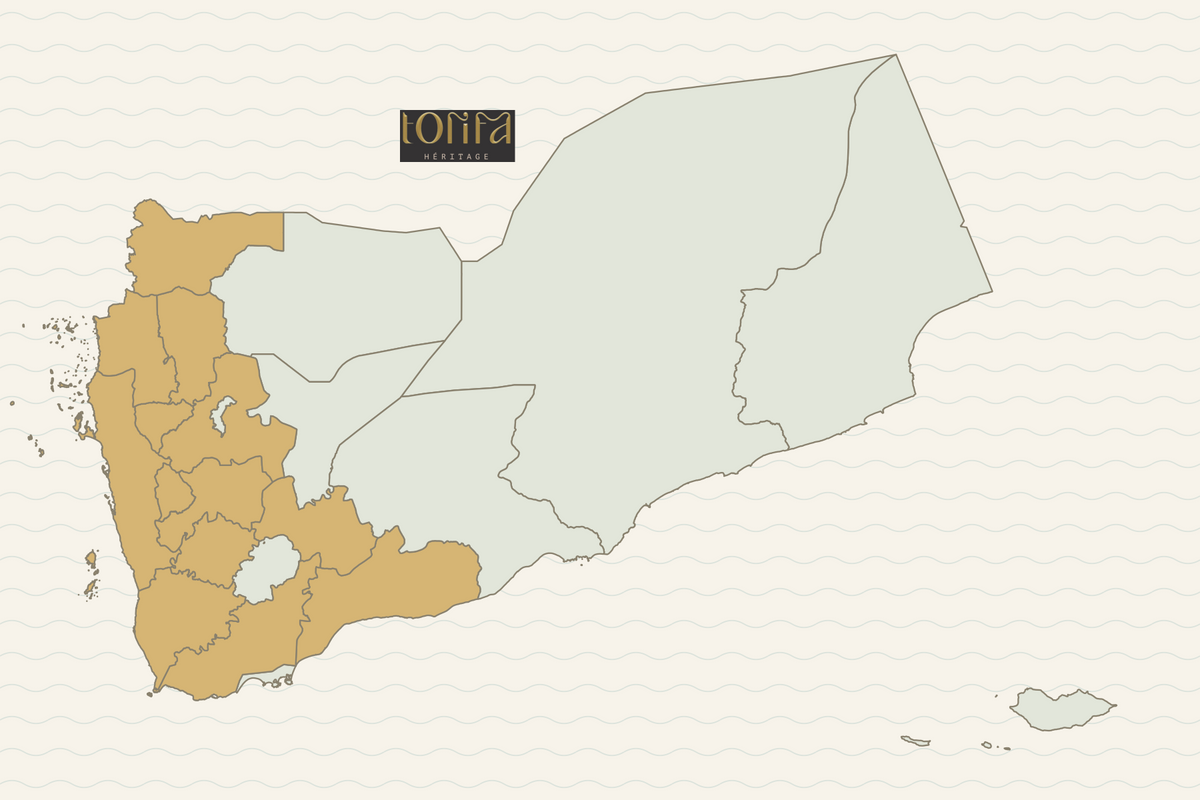
2,000 to 3,200 metres
Yemen's peaks rise above 3,000 metres. Our lots grow on their slopes, between 2,000 and 2,500 metres, on volcanic, colluvial and varied soils. It is the altitude at which the cherry ripens slowly.

A precious resource
In these mountains, water is a precious resource. The climate is dry, the nights are cool, and temperature swings are pronounced. Over the generations, the coffee tree has adapted to this demanding environment — a relationship between plant and surroundings that shapes the singular identity of Yemeni coffees.
The resources of the place
Farming practices rely largely on locally available resources: water collected on site, organic matter, natural soil amendments, and agricultural knowledge handed down from generation to generation, adapted to the constraints of the mountains.
 A village that climbs, because flat land is farmed

Varieties from another age
Some varieties grown in Yemen, such as Udaini, have been cultivated without interruption for more than five hundred years. Yemen holds a singular place in the history of arabica coffee: while its botanical origin goes back to the Ethiopian highlands, it was in Yemen that its cultivation developed and took shape before spreading to the world through the port of Mocha.
The cherries dry
on the rooftops.
A coffee's character is born from the meeting of place, plant and people.

Coffee did not lead me to Yemen.
It brought me back to a story that has travelled the whole world.
I am of Yemeni origin. For me, coffee is not a passion discovered on a journey: it is a story tied to my roots.
Yemen is not just a land where coffee grows. For centuries, its port of Mokha played a major role in the coffee trade and in its spread around the world. The name “mocha” still keeps its memory.
This story is part of my heritage. It made me want to introduce Yemeni coffees for what they are: singular coffees, shaped by mountain terroirs, the know-how of the producers and a tradition that is still alive.
With TORIFA, I want to renew this bond: working as close as possible to the producers, sharing their harvests and a story that the coffee world also owes to Yemen.
For me, every cup is a meeting between this story and the present. A way of making Yemeni coffee travel again, with respect for those who grow it.
Villages, families
TORIFA coffee takes root in villages, among families who have worked the land for several generations. Harvesting by hand, cherry by cherry, remains a gesture that is learned and passed on. TORIFA maintains a direct relationship with these producing families, built over time.
And we go back,
harvest after harvest.